
myHappymind programme
myHappymind is an NHS-backed curriculum focused on building resilience, self-esteem and happiness in children.
Content
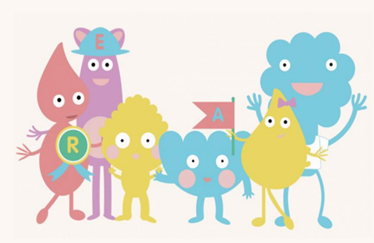
Every year group from Early Years to Year 6 has a separate version of the curriculum, with Year 6 focussing on transition. The lessons contain quizzes, songs and animations and feature the lovely characters below. The content is structured against five modules. Each Year group works through the 5 modules allowing for a whole school culture to build. There are also lessons on neurodiversity to enable the whole school community to better understand and embrace diversity.
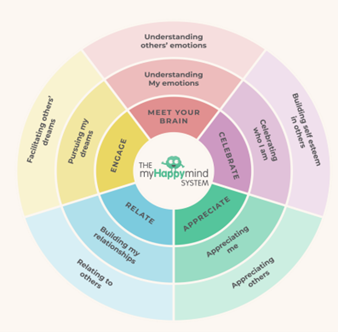
Module Summary
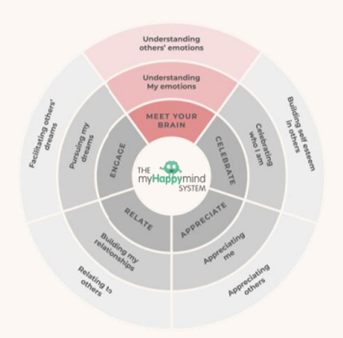
Meet Your Brain
Helping children to understand how their brains work and teaching strategies for relaxation.
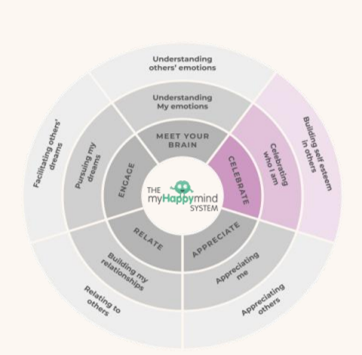
Celebrate
Building children’s self-esteem through recognising and celebrating their strengths.
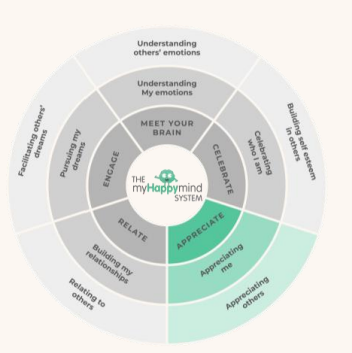
Appreciate
Developing a habit of gratitude! Teaching children the importance of thinking about what we are grateful for and sharing this with
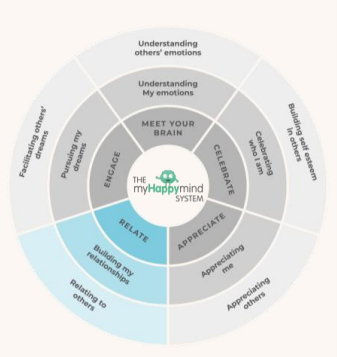
Relate
Introducing relationship building skills to ensure children have the foundations to form friendships, be heard and understand others.
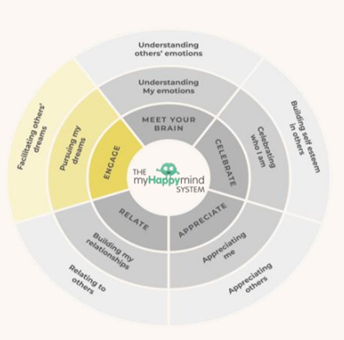
Engage
Introducing the power of goal setting to children so that they aspire, dream and learn to persevere.
How does it link to other things we do in school?
myHappymind isn’t just a topic or subject like Maths. It is a life skill that we can all learn to help us to be our very best selves. We will be having lessons each week, but we will be using the habits we learn all of the time. Even the teachers are doing myHappymind!
PSHE curriculum
The PSHE curriculum provides learning opportunities and experiences which enable pupils to:
- Develop confidence in talking, listening and thinking about feelings and relationships.
- Understand their personal rights and social responsibilities.
- Develop enduring values, integrity and autonomy in developing respect for their environments and their communities.
- Enhance their self- esteem and emotional development.
- Form and maintain satisfying relationships.
- Understand the importance of having good mental health.
- Recognise the characteristics of healthy and unhealthy relationships.
- Protect themselves (including online) and ask for help and support.
- Identify risks in a range of situations.
Our approach to PSHE:
Our whole school PSHE programme integrates RSE within the wider themes of the Personal, Social, Health, Citizenship and Economic Education curriculum.
We teach children in a way that is sensitive to their individual cultural and economic background.
We aim to equip our pupils with knowledge, understanding and skills to enable them to make decisions and choices, now and in the future, which will lead to positive relationships and a healthy lifestyle.
The PSHE curriculum is taught through termly themes. There are three topics within each core theme:
Autumn Term: Relationships
Families and Friendships, Safe Relationships, Respecting Ourselves and Others
Spring Term: Living in the Wider World
Belonging to a Community, Digital Literacy and Media Resilience, Money and Work
Summer Term: Health and Wellbeing
Physical Health and Mental Wellbeing, Growing and Changing and Keeping Safe
It is developed to ensure that pupils acquire knowledge, vocabulary and skills in a developmental and progressive manner, building on prior learning and following the content of the PSHE Programme of Study.
The Sex and Relationships Programme is mainly taught as part of the PSHE curriculum by the class teacher. However some elements are included and taught through other subjects, for example Science. Puberty is introduced in Year 4 although sex and relationships is delivered as part of a spiral curriculum throughout the school.
Parents have the right to withdraw their child from the non-biological aspects of sex education. However they are not able to withdraw their children from those aspects of sex education that occur as part of the National Curriculum for Science.